

Many companies still rely on traditional contact forms that collect vague and incomplete enquiries. A user types a few words, submits the message, and disappears. From a sales perspective, such leads are often low quality, lack context, and require additional work before they can be properly handled.
An AI Chat Assistant works differently. Instead of a single form, it guides the user through a structured conversation, gathers context, qualifies the need, and delivers a much better-defined lead to the company. This is not an AI gimmick. It’s a tool designed to increase conversion and improve lead quality.
In this article, we’ll show how such a system works in practice, what components it consists of, what the conversation flow looks like, and why it often outperforms traditional contact forms.
An AI Chat Assistant is a conversational system on your website that guides users step by step, asks qualifying questions, collects business context, and delivers a more detailed lead than a standard form. In practice, it improves enquiry quality, reduces response time, and supports sales automation.
Quick answer: An AI Chat Assistant increases lead quality and conversion by replacing static forms with guided conversations. It qualifies users in real time, collects structured data, and delivers ready-to-handle leads instead of incomplete enquiries.
- How an AI Chat Assistant works step by step
- What the conversation flow looks like in practice
- How an AI Chat Assistant qualifies leads
- How the system works technically
- Why chat performs better than forms
- How to implement an AI Chat Assistant
- How the system can evolve
How an AI Chat Assistant works step by step
An AI Chat Assistant operates as a structured conversation system that replaces or extends a contact form. Instead of presenting multiple fields at once, it guides users through a sequence of questions tailored to the service type.
In practice, the process starts when a user visits the website and opens the chat. They then choose an area of interest—such as SEO, website development, AI for business, automation, or consultation. From that point, the system directs the conversation and asks questions that have real sales value, not just formal data collection.
The key difference is that the chat doesn’t try to “talk about everything.” Its purpose is to guide the user from initial interest to a specific enquiry. That’s why this model works better for lead generation than a basic chat widget or standard form.

What the conversation flow looks like in practice
The effectiveness of the system depends on a well-designed flow. In a real implementation, the conversation is not random. First, the user selects a service, then answers questions about priorities, project stage, industry, website, main need, and preferred contact method. Only at the end do they provide contact details and see a summary.
This structure has clear business value. The company doesn’t just receive a message saying “I’m interested.” It receives a lead with context: what the issue is, what stage the client is at, what problem they have, whether they already have a website, and how they prefer to be contacted. This means fewer empty conversations and more meaningful enquiries.
A well-designed conversation flow doesn’t try to imitate a human. It guides the user toward a decision and collects the data needed to handle the lead.
How an AI Chat Assistant qualifies leads
The biggest advantage of this system is lead qualification. A traditional form typically collects only a name, email, and a short message. That’s not enough to assess whether the enquiry is valuable, urgent, or relevant. An AI Chat Assistant collects more data—but in a natural, conversational way.
In practice, the system gathers fields such as: service area, qualification response, project stage, industry, website URL, main need, preferred contact method, name, email, and phone number. This allows sales teams to immediately understand what kind of enquiry they are dealing with.
This is crucial because lead quality is not defined by whether someone leaves a phone number—it depends on whether the company understands what the client actually needs. The AI Chat Assistant organises this information before the first contact.
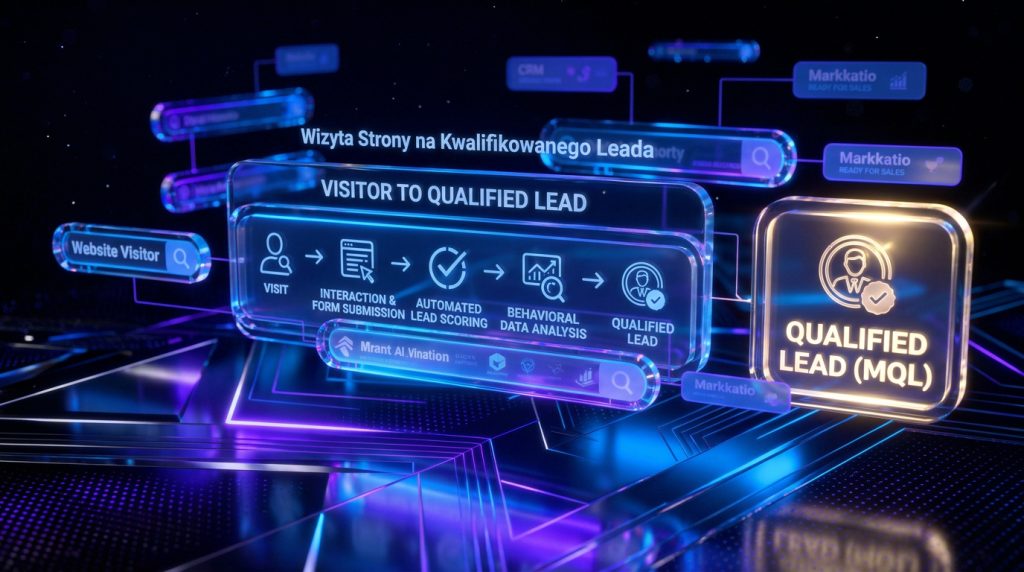
How the system works technically
From a technical perspective, the system doesn’t need to be complex at the beginning. A basic version consists of a custom JS widget, question logic, a visual interface, a hidden form, and integration with a lead collection system.
After the conversation, user data is mapped into specific form fields. These typically include name, email, phone, service interest, industry, website, and a structured description built from priorities, stage, contact preference, and main need. This ensures that a lead is not just a contact, but a complete, context-rich enquiry.
In later stages, the system can be integrated with CRM platforms, Make, n8n, Slack, Jira, or Airtable. This means the chat can not only collect leads but also trigger further sales and customer service automation.
Why chat performs better than forms
A traditional form is easy to implement but often weak in terms of sales performance. It requires users to describe their problem without guidance. For many users, this creates friction—they don’t know what to write, how detailed to be, or whether their question is appropriate. As a result, they either submit vague messages or abandon the process.
An AI Chat Assistant guides users step by step. It asks one question at a time, structures responses, and reduces friction. This improves user experience and increases the chances of receiving a complete enquiry. Instead of a blank message field, you get a structured process similar to a mini consultation.
This is why chat works better than forms—especially for service-based websites, consultations, AI implementations, automation, or web development projects. The more complex the service, the more valuable a conversation becomes.

How to implement an AI Chat Assistant
Implementation should start with process—not technology. First, define what types of enquiries you want to collect, what information is truly necessary, and which questions help filter out low-quality leads. Without this, even a well-designed chat becomes just another widget.
The next step is designing the conversation flow. Questions should be short, specific, and tailored to each service. The way you talk to someone interested in SEO differs from someone looking for a new website or AI implementation. Only then does the system function as a sales tool, not just a chat.
Finally, the technical layer is added: widget implementation, form or CRM integration, notifications, and automation. The system works best when it is part of a broader sales process—not a standalone feature.
How the system can evolve
The basic version of an AI Chat Assistant doesn’t need to rely on large language models immediately. A well-designed flow alone delivers real business value. Over time, the system can be expanded with memory, intent recognition, FAQ responses, industry-specific variants, and integrations with CRM, Slack, Jira, or Make.
This is important because many companies ask: “Does it need full AI from the start?” In practice—no. First, build an effective lead qualification system. Then add AI where it creates real value: understanding intent, analysing input, answering questions, or suggesting next steps.
In the long term, this system can become part of a broader sales architecture. It can function as a contact assistant, sales assistant, or automation tool for the first stage of customer interaction. That’s why it should be treated as part of a growth system—not just a chat widget.
Summary
An AI Chat Assistant works best when implemented as a structured lead generation and qualification system—not as a trendy chatbot. Its advantage over forms comes from guiding users, reducing friction, structuring responses, and delivering much higher-quality enquiries.
This solution is especially effective for services that require context—SEO, web development, automation, consultations, and AI implementations. The more complex the offering, the greater the advantage of conversation over forms.
Most importantly, this system doesn’t end with chat. It can become the foundation of a broader sales and automation architecture, where the website actively supports customer acquisition instead of just collecting contacts.
It guides users through a structured conversation, asks qualifying questions, and collects data that is sent to a form, CRM, or lead management system.
Yes, in many cases it can replace or enhance a form by guiding users step by step and collecting more detailed context.
No. A basic version can work without AI and rely on a well-designed conversation flow. AI can be added later.
It works best for service-based businesses, agencies, consultants, tech implementations, and any business that requires lead qualification.
It provides more context, improves lead quality, reduces irrelevant enquiries, and shortens the path to meaningful sales conversations.

Turn your website into a lead-generating machine with AI
Your website shouldn’t just inform — it should convert. The AI Assistant helps capture leads, qualify visitors, and guide them towards the right solution in real time.
See how you can use AI to increase conversions, automate communication, and turn traffic into real business opportunities.
No forms. No waiting. Start conversations instantly.